The practical answer.
Meaningful cell matching starts with an approved cell identity and revision, then compares relevant measurements under the same preparation, temperature and test method. Capacity, resistance, open-circuit voltage and self-discharge observations answer different questions. An OEM should request the supplier's controlled acceptance method, permitted distributions and traceability into the finished pack rather than impose one universal matching percentage.
- The same printed capacity does not establish the same cell or the same measured behavior.
- A resistance value is comparable only with its method and conditions.
- Matching is one manufacturing control, not proof of finished-pack safety or lifetime.
- The records requested below concern qualified suppliers, not DIY assembly or cell sorting.
Begin with identity before comparing measurement distributions
A matching discussion is premature if the approved cell itself is ambiguous. Record the manufacturer, exact model, relevant specification revision and permitted supply identity. A capacity class such as 3 Ah or 3.5 Ah is not a unique material definition. Different cells can share a headline capacity while having different power behavior, dimensions or application restrictions. The finished-pack bill of materials should define which identity is permitted and how a proposed substitution is reviewed.
Ask how incoming cell identity is connected to the finished-pack serial or lot record. The supplier may retain detailed cell-level data internally while providing an agreed summary and retrieval path to the customer. What matters is that a later investigation can locate the relevant batch, method and assembly configuration. A polished histogram with no link to delivered packs provides little evidence about the purchased configuration.
This article concerns selection and evidence within a qualified manufacturing process. It does not recommend combining loose cells, opening a pack, reusing unknown cells or performing unsupervised sorting. The purchasing task is to establish what controls the supplier uses and what evidence supports the approved assembly.
Resolve specification revisions instead of merging convenient values
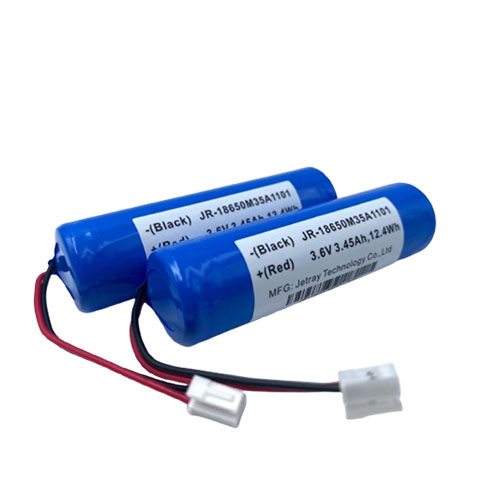
Public information can contain different levels of detail or inconsistent summaries. In the sources checked for this article, Molicel's M35A product page lists a rounded 3.5 Ah typical capacity, while its official version 1.4 product sheet lists 3450 mAh typical and 3350 mAh minimum. Jetray's public M35A pack listing uses another capacity description. These observations are a reason to request the current governing specification; they do not establish that the documents describe identical approval conditions.
Do not combine the largest capacity from one page, the highest charge current from another and a resistance threshold from a third into a fictional composite product. Separate bare-cell data from finished-pack requirements. The approved assembly specification must identify the relevant cell document and any additional restrictions introduced by protection electronics, wiring or the application. Conflicting public details remain unresolved until the supplier reconciles them.
This document-control step is also useful when alternate cells are proposed. A supplier should identify what changes, which evidence remains applicable and what needs renewed evaluation. Similar headline values do not make a change administratively trivial.
Use different measurements for different kinds of inconsistency
Capacity testing compares delivered charge under a defined preparation and discharge procedure. Resistance measurements examine a particular electrical response. Open-circuit voltage describes a resting voltage under stated conditions. A self-discharge observation examines change over time. None of these metrics alone completely describes a cell, and close agreement in one does not guarantee agreement in the others.
For example, cells with similar resting voltage need not have equal usable capacity. Likewise, one low resistance reading does not establish capacity, storage history or suitability for a particular pulse profile. Ask which failure or variation each screening stage is intended to detect. That explanation is more informative than a long checklist whose acceptance criteria have no connection to the product's duty cycle.
| Evidence | Useful question | Condition that must accompany it |
|---|---|---|
| Approved identity and lot | Are these the permitted cells? | Manufacturer, model and controlled revision |
| Reference capacity distribution | How does delivered charge vary? | Preparation, temperature, load and endpoint |
| AC resistance distribution | How does a defined small-signal response vary? | Frequency, instrument and fixture method |
| DC pulse response | How does voltage response vary under a timed load? | State of charge, pulse and observation time |
| Resting voltage trend | Is there an unexpected change during the observation interval? | Temperature, elapsed time and measurement capability |
| Finished-pack records | Can the evidence be connected to delivery? | Serial or lot linkage and retained process revision |
Make resistance comparisons method-specific
An AC resistance value and a DC pulse-derived value should not be treated as interchangeable numbers. Hioki describes AC and DC methods as complementary measurement approaches. NI's DCIR documentation notes that the result varies with state of charge, temperature and pulse duration. These conditions explain why a supplier's report needs a method, not merely a milliohm limit.
Keep measurement boundaries consistent. A bare-cell terminal measurement and a completed pack measurement include different electrical paths. The pack result can contain contributions from interconnects, protection and the external interface. A difference between them is not automatically evidence of poor cells. Ask for the intended test boundary and the way the supplier separates cell selection from finished-assembly checks.
A procurement requirement such as all cells within a fixed percentage is incomplete until the denominator, method, preparation and uncertainty are defined. Avoid inventing an acceptance band from a generic article. The permitted distribution should be justified for the approved design and the supplier's validated process.

Treat temperature, state and elapsed time as part of the sample
A measurement result belongs to both an item and a state. If one group is measured after a different charge preparation or while it is still changing temperature, the apparent spread can include procedural variation. Require the supplier to define the preparation and stabilization method appropriate to its process. The same applies to rest time after a preceding electrical operation.
Self-discharge screening particularly depends on time and measurement capability. A single resting-voltage reading is not a trend. Ask for the observation interval, environmental control, instrument capability and decision method, rather than prescribing an arbitrary number of hours. Cell voltage can change for reasons other than an internal defect, so interpretation should remain with the qualified process and its reference evidence.
Store the condition data with the result. If a measurement is later repeated at the buyer's site, reproduce the agreed procedure before comparing values. A dispute between dissimilar methods is a method-reconciliation problem first; it does not become proof of a defective lot merely because both instruments display milliohms or volts.
Review distributions and drift rather than accepting a single average
An average can hide tails, mixed populations or a shift between lots. Request the reporting format needed for the decision: sample size, range or distribution, relevant outliers and the process response when a limit is exceeded. The commercial summary need not expose proprietary sorting software, but it should make clear what was measured, which limits governed and whether the delivered configuration met them.
Trend data help distinguish a stable process from a one-off sample selection. Ask how the supplier monitors changes in incoming cell supply, equipment, fixtures and preparation. If the measurement system changes, apparent process drift may actually be a new measurement baseline. Records should retain enough revision information to investigate that distinction.
The purpose is not to demand zero natural variation or perfect numerical identity. It is to establish a controlled, justified variation range and an appropriate response to deviations. Matching should support the finished pack's requirements rather than become an isolated marketing claim.
Confirm what matching does not establish
Matched incoming cells still need an appropriate assembly design and manufacturing process. Interconnect quality, thermal paths, protective functions and installation conditions affect the finished result. A cell distribution report therefore cannot replace pack-level qualification or the required model-specific compliance evidence. It also cannot establish lifetime in a new application merely because the first set of measurements is close.
Thermal conditions can change during real operation even when the initial cell measurements are similar. A location near a warm component or a less effective cooling path can expose cells to different operating histories. The thermal-management article in this batch treats that installed question separately. Keep the electrical screening evidence and the assembled-pack validation connected, but do not present one as a substitute for the other.
The linked 18650 references provide actual product inquiries within this catalog. Their family image and public figures are not evidence that a requested matching protocol has been applied to a delivered batch. Ask for the governing finished-pack specification and a response to the evidence fields above.
- Freeze approved cell identity, revision and substitution rules.
- Agree measurement methods, preparation and justified acceptance distributions.
- Confirm how results are linked to finished-pack delivery records.
- Review process changes and outlier handling with the supplier.
- Retain separate finished-pack electrical, thermal and compliance evaluation requirements.
Questions for a cell-consistency review
Can equal open-circuit voltage prove equal capacity?
No. They describe different quantities and conditions. Ask for the approved capacity method where capacity matching is relevant, and use resting-voltage evidence for the purpose defined by the supplier's screening process.
Should every OEM impose the same resistance spread?
No universal spread is established here. A useful limit depends on the measurement method, the product requirement and the controlled manufacturing process. Ask the supplier to justify the proposed criterion and explain its relationship to finished-pack validation.
What should a buyer retain after approval?
Retain the approved cell and pack identities, governing documents, method descriptions, agreed summary data, lot linkage and change-notification requirements. These records make a later supply change assessable and keep a claim of matched cells connected to the actual product purchased.
Sources & further reading
- Molicel: INR-18650-M35A product page ↗
- Molicel: INR-18650-M35A official product data sheet version 1.4 ↗
- NI: Direct Current Internal Resistance Testing ↗
- Hioki: battery internal resistance measurement principles ↗
- Jetray: M35A-based 18650 pack public reference ↗
- Jetray: factory image source ↗
AI-assisted editorial content fact-checked against linked primary sources. Public M35A summaries contain differing capacity descriptions; only a current supplier-approved specification can resolve the governing pack requirement. No universal matching limit, completed test, certification or individual engineer review is claimed.
Prepared for the 18650 battery packs collection. General engineering guidance does not replace a model-specific datasheet or application validation. Source review: 5 November 2026.